Black Weeks15% off everythingEnds 30 November
Log in
Cart

You do not have any products in your shopping cart yet.

FAQ


» Tech Tips
P2261 fault code after fitting a DV+ T9661

Problem:

After fitting the DV+ with part number T9661, a fault is shown in the instrument cluster. Reading the ECU reveals fault code P2261.


Solution:

The P2261 fault code is directly related to the preload of the piston spring, which can be adjusted via the screw on the side of the valve. Make sure you set it to the softest setting and, after clearing the fault, check whether it comes back.
 
How sensitive the vehicle is to this fault code depends on the modifications made. A remap that makes the boost build quickly can often increase the likelihood of triggering the fault code.
 
Also check that the valve moves freely and vents properly: when it is set to 100% open, it should make a "whoosh" sound immediately on throttle lift-off, and there should be no fluttering noise (i.e. no turbo surge). 
 
To find the optimum spring preload setting, we recommend the following guide.


Solution (original GFB wording):

The P2261 fault code is directly related to the spring preload that can be adjusted through the screw on the side of the valve. Make sure you adjust it to the softest setting, and see if that helps.
 
The car’s sensitivity to this fault code is dependent on mods; often a tune that makes boost come on more aggressively can make it more likely to throw this code, because of what it measures in relation to that fault code.
 
Also check that the valve is moving freely and venting properly, in that when it is set to atmosphere, it readily makes a “whoosh” sound immediately upon lift-off, and there’s no fluttering noise (i.e. no turbo surge). 

Re-calibrating the servo motor on a GFB Deceptor Pro II
The steps below detail how to re-calibrate your Deceptor Pro II unit should the control dial position no longer match the valve position.
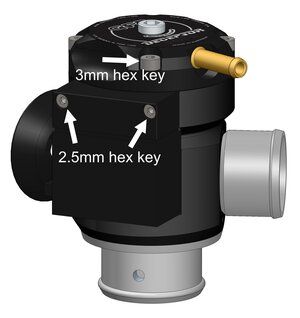
  1. Remove the servo motor from the Deceptor Pro by unscrewing the two socket screws that hold it to the body (use a 2.5 mm metric hex key), and the single socket screw indicated on the cap (use a 3 mm hex key).

    GFB Deceptor Pro II Rekalibrierung 

  2. Connect the servo motor cable to the controller, and confirm that it operates by turning the dial a few times.  Turn the dial fully anti-clockwise to set the motor in the full recirc position.


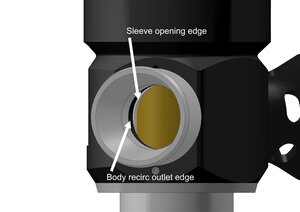
  3. Manually turn the valve sleeve to the full recirc position using your thumb on the exposed gear (diagrams opposite).  You are in the full recirc position when the trumpet port is fully closed, and on the recirc port the inner sleeve opening edge lines up with the body recirc outlet edge as shown. When these edges are aligned, turn the sleeve 1-2 gear teeth further to ensure full trumpet outlet closure.

     GFB Deceptor Pro II RekalibrierungGFB Deceptor Pro II Rekalibrierung

  4. Re-attach the servo to the valve, then turn the dial back and forth a couple of times to confirm operation.


  5. Turn the dial fully anti-clockwise and check that the trumpet outlet fully closes.  If it does not fully close, or it closes too far, remove the servo and repeat the procedure, but this time change the position of the gear in step 3 by one gear tooth in the appropriate direction before re-fitting the servo.  


Essentially, you are just looking to get the servo meshed to the valve gear in the right position for the “home” recirc location. 
 

DV+ T9351 Tech Tip

The DV+ can basically be installed in two different ways, depending on your own preference and what you want to achieve.

When installing, you can choose whether or not to fit the main piston spring (see arrow in the image below).


GFB DV+ Ventil Aufbau und Montage


Using the spring is recommended, as it gives the best possible response and minimal throttle lag on gear changes (especially on cars with a manual gearbox). This can sometimes make the car sound a little different than usual, particularly at low revs. This is normal, however, and results from the way the valve works.

However, if you find the noise unpleasant, the main piston spring can be removed. The valve then works exactly like the OEM valve, but at the expense of response.

To make it even clearer: on petrol engines, minimal lag on gear changes is achieved when the diverter or blow-off valve vents only as much air as is needed to prevent compressor surge. Venting more air than necessary results in poorer response on gear changes, because the pressure in the charge-air system has dropped, which means it takes longer to get back to the previous boost level when the throttle is opened again.

This is the basis of GFB’s TMS principle and also the principle on which all GFB valves are based.

The DV+ is no exception, as (unlike the OEM valve) it opens depending both on the ECU actuation AND on the boost pressure present. So when the engine management actuates the valve, the DV+ piston only opens as far as the pressure in the charge-air system can push it against the spring. The OEM valve, by contrast, opens regardless of the boost pressure present.

The different noises you may hear on throttle lift-off at low revs occur only because of this different way of working. They have no negative effect whatsoever on the engine or turbocharger. If the spring is removed, the DV+ simply opens and closes when the ECU actuates it – exactly as the OEM valve does. Boost pressure is still held, but the advantage of the TMS principle is lost, so the engine’s response is the same as with the stock valve fitted.